Train your staff like it's day one
Standards erode across a season unless they are reinforced. A three-part approach to training that survives turnover and mid-summer fatigue.
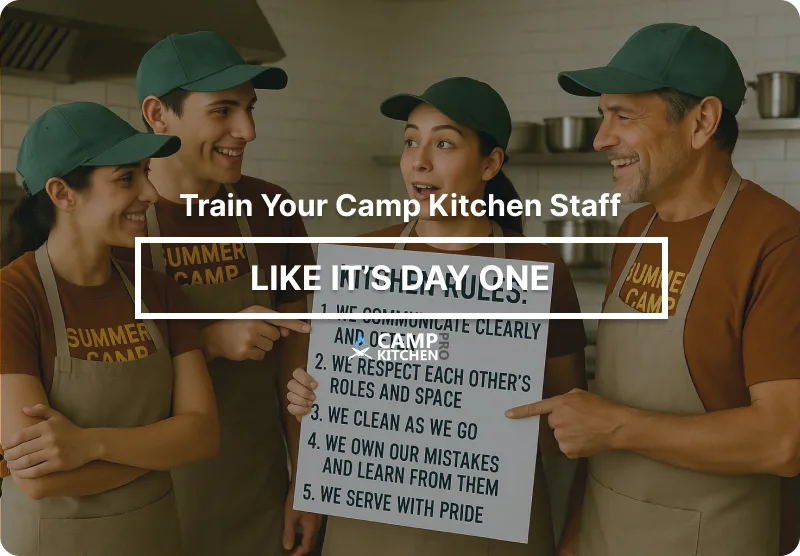
Most camp kitchens train hard in the first week and then stop. It is understandable: the season starts and there is no time. But standards that are not reinforced drift, and by August the way things get done bears little resemblance to how they were taught.
Ongoing training is not a sign that orientation failed. It is what keeps allergen protocols and sanitation habits present in people’s minds when they are tired.
Document it once, teach it forever
When a process lives only in an experienced cook’s head, it leaves when they do. Written systems (recipe instructions, inventory procedures, opening and closing routines) mean the knowledge stays with the kitchen.
Kept somewhere central and current, documentation turns onboarding from a week of shadowing into something a new hire can start using on day one. It works best alongside the wider systems that control food cost, since the same written standards drive both.
Short and frequent beats long and once
A five-minute huddle before service does more than a three-hour orientation in May.
Brief, regular touchpoints let you recalibrate without it feeling like a reprimand. Mention the thing that slipped yesterday, confirm today’s allergen situations, and move on. Repetition is what makes a standard normal rather than aspirational.
Let returners train the rookies
Staff coming back for a second or third season already know how the kitchen runs. Given clear systems to teach from, they become the fastest route to consistency.
This works because it multiplies your training capacity, and because standards spread more readily between peers than down from management.
The result
A kitchen that does not depend on any one person’s memory. Meals come out the same whoever is on, new staff become useful quickly, and the systems hold up when someone leaves mid-season. The ACA covers how camp kitchen operations are changing as more camps move to documented systems.
That is what makes it possible to think about the food rather than the process.